









Poland Vacancies squeeze regional offices
Office & mixed-use development
High vacancy rates, limited development activity, and a shift in demand demonstrate a market still seeking equilibrium after the rapid growth of the previous decade.
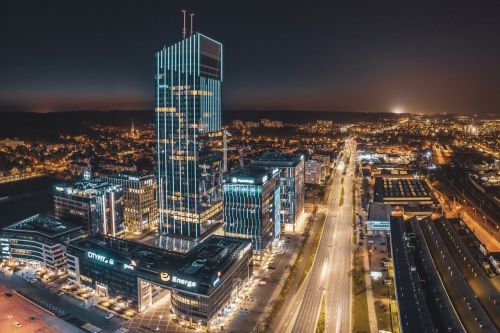
The total office supply in the eight largest Polish regional cities comes to 6.76 mln sqm, almost half a million square metres more than Warsaw's office stock. The market is highly concentrated. Kraków (1.85 mln sqm), Wrocław (1.36 mln sqm), and the Tricity (1.07 mln sqm) together account for almost two-thirds of the entire regional supply.
Demand in Q1 reached 121,500 sqm. The lowest result recorded in the first quarter since the beginning of 2021 and represents a 29 pct year-on-year decline. The Tri-City region led in tenant activity, with 49,500 sqm leased, or 41 pct of the total volume. Wrocław was next with 25,500 sqm, and Kraków, where demand reached 16,700 sqm. The sectors driving leasing activity were manufacturing, accounting for 18 pct of transactions, business services with a 17 pct share, and IT with a 13 pct share. New deals accounted for 51 pct of the volume, and renegotiations 37 pct.
The Tri-City region performed very strongly in the latest report, but this shouldn't be viewed solely from the perspective of a single quarter. It's a market that has been building its position quite consistently for a long time: it has a diverse tenant base, good access to staff, and the quality of life argument, which is truly important in negotiations with companies. Therefore, with tenants' increased caution, the Tri-City can still attract demand. It's not a risk-free market, but compared to the largest regions, it's closest to equilibrium.
Piotr Skuza, Associate Director, regional manager, office agency, Savills
The average vacancy rate for regional office markets is 17.4 pct, representing 1.18 mln sqm of available space. The highest levels are recorded in Katowice (22.1 pct) and Wrocław (22.0 pct). High availability also remains in Łódź (19.6 pct) and Kraków (18.4 pct). The Tri-City region, with 10.8 pct of offices waiting for tenants, and Szczecin, with a vacancy rate of 7.9 pct, stand out positively.
Kraków and Katowice present two distinct office landscapes. Kraków is the largest market outside of Warsaw and remains a natural choice for many large organisations, but its scale also means intense competition among buildings. Katowice, on the other hand, has undergone a significant qualitative change in recent years and boasts an increasingly improved office product. However, with the highest vacancy rate among large regional markets, they must compete harder for every tenant's decision. In both cities, we see that companies are no longer looking solely at square footage and address. They are looking at space efficiency, employee availability, accessibility, costs, and whether the office will help them bring people back to in-person work.
Marcin Gawlik, associate director, office agency, Savills
Wrocław remains one of the most important office markets in the country, but the rules are different today than they were a few years ago. With such abundant space, tenants aren't making decisions under pressure. They are examining costs, quality of management, contract flexibility, and whether the office truly meets the needs of their teams. Therefore, landlords must compete not only on address and building standards, but also on the ability to ensure the entire tenant experience.
Dorota Kościelniak, director, office agency, Savills
Development activity remains at a historically low level. Less than 180,000 square meters of space is under construction. Offices, 11% less than a year earlier and several times less than in previous cycles. For comparison, between 2015 and 2019, an average of over 900,000 square meters of office space was under construction.
Development activity is concentrated primarily in Poznań, where 72,900 square meters is under construction, and in Kraków, with 50,400 square meters. Although 47,200 square meters of office space were delivered in the first quarter alone, more than in all of 2025, this year's total supply will remain significantly below the multi-year average.
Today, no one in Poznań is renting offices "in advance." Decisions are cautious, carefully considered, and usually preceded by a lengthy cost analysis. Therefore, the low leasing volume in the first quarter is not surprising, and the large space under construction will be a significant test. New projects must precisely address companies' needs: location, efficient layout, operating costs, and flexible terms. In Poznań, a new building alone is not enough. The key is and will continue to be the matching of space, costs, and lease terms to the specific needs of companies.
Mateusz Jakubowicz, associate
In the coming quarters, the pace of absorption of existing vacant space will be crucial. Limited new supply may help stabilise the market, but only if tenant activity gradually returns.

Sales up, supply down
JLL Polska
In the first quarter of 2026, the Polish housing market recorded a significant increase in sales. A total of 12,900 apartments were sold across the country's seven largest cities ( ...
Rent isn't everything. The real costs of leasing warehouse space
Newmark Polska
Choosing a new warehouse takes much more than simply comparing rental rates across a few or even a dozen centres. With rising energy costs and varying technical standards, the actu ...
A good foundation from which to grow
CBRE
Poland's role and the strength of its economy are increasingly visible in the European commercial real estate market. We have strengthened our leading position in Central and Easte ...